
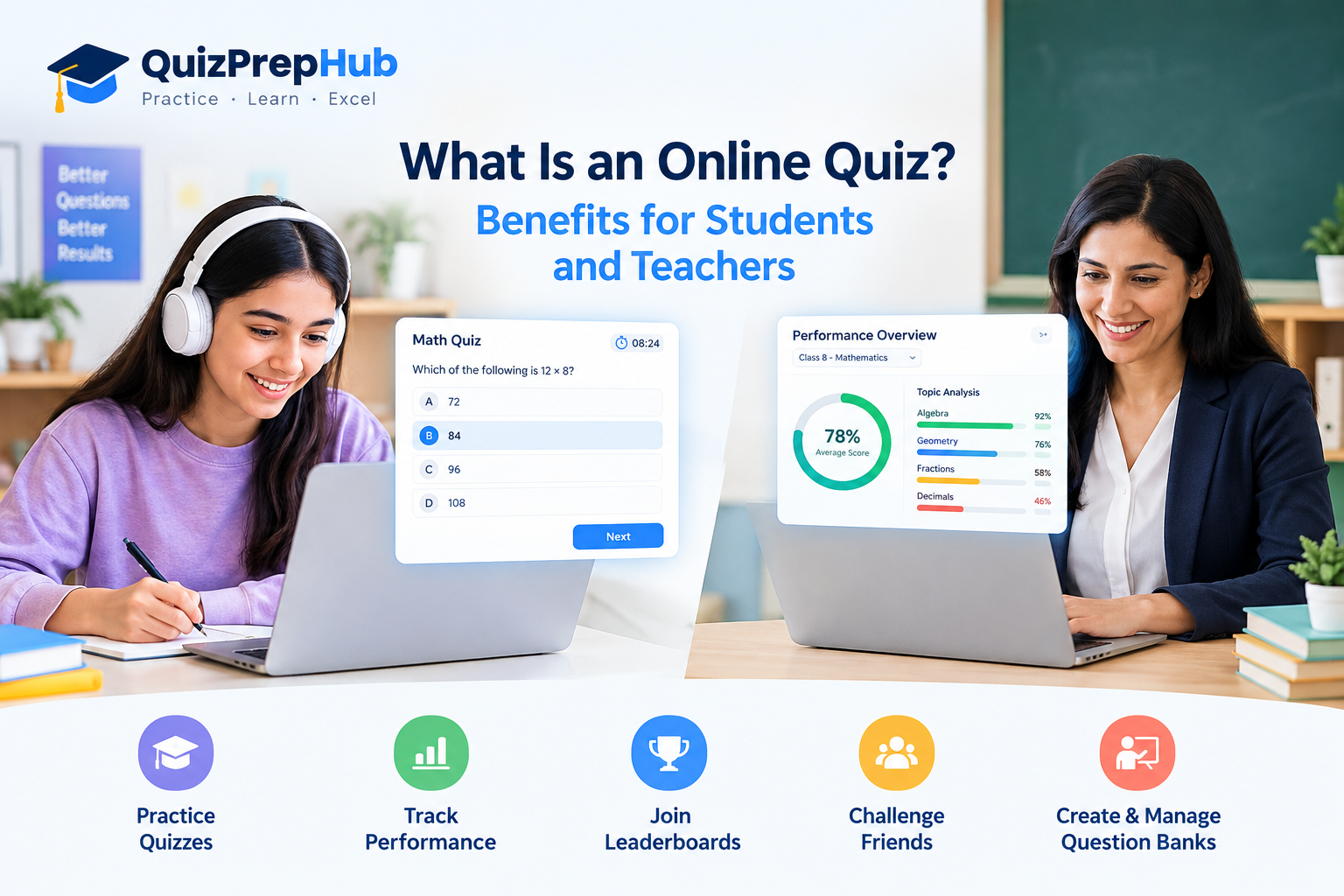
<p>Online quizzes have changed how students practice, how teachers assess learning, and how classrooms track progress. Instead of relying only on paper-based tests, students and teachers can use digital quizzes to check understanding, review answers, and identify topics that need more attention.</p><p>For students, an online quiz provides a convenient way to practice before an exam and measure their progress. For teachers, it offers a practical way to create assessments, share them with students, and understand how well the class is performing.</p><p>In this guide, you'll learn what an online quiz is, how it works, its benefits for <a target="_blank" rel="noopener noreferrer" href="https://app.quizprephub.com/?role=student">students</a> and <a target="_blank" rel="noopener noreferrer" href="https://app.quizprephub.com/?role=teacher">teachers</a>, and how to use online quizzes more effectively.</p><h2>What Is an Online Quiz?</h2><p>An <strong>online quiz is a digital assessment that allows students to answer questions using a computer, tablet, or mobile device.</strong> It can be used to test knowledge, practice a subject, review a lesson, or measure learning progress.</p><p>Online quizzes may include multiple-choice questions, true-or-false statements, short-answer questions, matching activities, and other question formats, depending on the platform.</p><p>Unlike a traditional paper quiz, an online quiz can be distributed digitally and may provide immediate results, automated scoring, explanations, or performance reports.</p><p>For example, a student studying mathematics can take a 20-question quiz on fractions. After completing it, the student may receive a score and review incorrect answers to understand which concepts require additional practice.</p><p>A teacher can use the same type of assessment to evaluate an entire class, identify commonly misunderstood topics, and plan the next lesson.</p><p><strong>In simple terms:</strong> An online quiz helps students check what they know and helps teachers understand what their students have learned.</p><h2>How Does an Online Quiz Work?</h2><p>The process depends on the quiz platform, but most online quizzes follow a similar workflow.</p><h3>Step 1: Choose a subject or topic</h3><p>A student selects a subject, such as mathematics, science, English, or history. The quiz may cover an entire subject or focus on a particular topic.</p><p>Teachers can also prepare topic-specific quizzes to assess a lesson or unit.</p><h3>Step 2: Answer the questions</h3><p>The student opens the quiz and answers the available questions. Some quizzes have a time limit, while others allow students to work at their own pace.</p><h3>Step 3: Submit the quiz</h3><p>After answering the questions, the student submits the quiz. The platform processes the responses according to its scoring rules.</p><h3>Step 4: Review the results</h3><p>Depending on the platform and question types, students may see their score, correct and incorrect answers, explanations, or a detailed performance report.</p><h3>Step 5: Identify areas for improvement</h3><p>Students can use the results to identify topics that need more practice. Teachers can review class performance to determine whether a lesson needs further explanation or additional exercises.</p><h3>Step 6: Practice again and track progress</h3><p>Students can take additional quizzes to reinforce their understanding and compare results over time, where the platform supports progress tracking.</p><p>The real value of an online quiz is not simply completing the questions. It is using the results to decide what to learn next.</p><h2>What Are the Benefits of Online Quizzes for Students?</h2><p>Online quizzes can make exam preparation more structured, interactive, and measurable. Here are some of their most useful benefits.</p><h3>1. Check your knowledge before an exam</h3><p>Reading textbooks and reviewing notes are important parts of studying, but they do not always reveal whether you can recall and apply what you have learned.</p><p>Practice quizzes help students test their understanding before exam day.</p><p>For example, a student may feel confident after reading a science chapter but discover through a quiz that they cannot answer questions about the water cycle correctly. This gives the student a specific topic to review.</p><p>Regular self-testing can help students identify gaps earlier rather than discovering them during an important examination.</p><h3>2. Identify weak subjects and difficult topics</h3><p>A total score does not always tell the whole story.</p><p>Imagine a student takes a mathematics quiz covering fractions, decimals, and percentages.</p><table style="min-width: 75px;"><colgroup><col style="min-width: 25px;"><col style="min-width: 25px;"><col style="min-width: 25px;"></colgroup><tbody><tr><th><p>Topic</p></th><th><p>Questions answered correctly</p></th><th><p>Score</p></th></tr><tr><td><p>Fractions</p></td><td><p>9 out of 10</p></td><td><p>90%</p></td></tr><tr><td><p>Decimals</p></td><td><p>8 out of 10</p></td><td><p>80%</p></td></tr><tr><td><p>Percentages</p></td><td><p>4 out of 10</p></td><td><p>40%</p></td></tr></tbody></table><p>The student has performed well on fractions but needs more practice with percentages.</p><p>This simple breakdown makes it easier to create a focused revision plan instead of spending equal time on every topic.</p><p>When a quiz platform provides topic-level reporting, students and teachers can use that information to prioritize practice.</p><h3>3. Receive feedback and learn from mistakes</h3><p>Incorrect answers can be valuable learning opportunities.</p><p>When available, answer explanations help students understand why an answer is incorrect and how to approach the question correctly.</p><p>A useful review process is to:</p><ol><li><p>Identify the questions answered incorrectly.</p></li><li><p>Read the explanations or revisit the relevant lesson.</p></li><li><p>Try a similar question to check understanding.</p></li><li><p>Take another quiz later to see whether performance improves.</p></li></ol><p>Simply checking a score and moving on misses an important opportunity to learn.</p><h3>4. Make exam preparation more engaging</h3><p>Repeatedly reading notes can become monotonous. Quizzes introduce an interactive element that encourages students to participate actively in their learning.</p><p>Some platforms also include points, achievements, challenges, or leaderboards. These features can make practice feel more engaging by giving students clear goals and opportunities to measure their progress.</p><p>However, competition should remain supportive. Students should be encouraged to improve their own results rather than judge their ability solely by their position on a leaderboard.</p><h3>5. Track improvement over time</h3><p>One quiz provides a snapshot of performance. Results from multiple quizzes can help students understand whether their preparation is improving.</p><p>For example:</p><table style="min-width: 50px;"><colgroup><col style="min-width: 25px;"><col style="min-width: 25px;"></colgroup><tbody><tr><th><p>Practice session</p></th><th><p>Score</p></th></tr><tr><td><p>First quiz</p></td><td><p>50%</p></td></tr><tr><td><p>Second quiz</p></td><td><p>65%</p></td></tr><tr><td><p>Third quiz</p></td><td><p>80%</p></td></tr></tbody></table><p>This example shows an improvement across three practice sessions. It does not prove mastery of the entire subject, but it gives the student a useful indication of progress.</p><p>Students can set achievable targets, focus on difficult topics, and use subsequent assessments to evaluate whether their study strategies are working.</p><h3>6. Practice from different devices</h3><p>Web-based quizzes can make practice more convenient when students have access to an internet-connected device.</p><p>Students may be able to take quizzes at home, during a study session, or in a classroom without needing to print a new worksheet for every attempt.</p><p>Actual access depends on the platform, device compatibility, and internet availability.</p><h3>7. Build confidence through preparation</h3><p>Students may feel uncertain before an exam because they do not know how well they understand the material.</p><p>Practice quizzes offer a way to check readiness, discover weaknesses, and work on them before the actual assessment.</p><p>As students become more familiar with question formats and improve their understanding, they may feel better prepared for examinations.</p><p>Confidence should come from demonstrated learning and preparation, not just from achieving a high score on one easy quiz.</p><h2>What Are the Benefits of Online Quizzes for Teachers?</h2><p>Online quizzes are useful not only for students. They can also help teachers organize assessments and make more informed instructional decisions.</p><h3>1. Create and reuse question banks</h3><p>A question bank is a collection of assessment questions organized for future use.</p><p>Teachers can build question banks around subjects, chapters, topics, or difficulty levels. A reusable collection can reduce the need to recreate similar assessments from scratch.</p><p>For example, a Grade 5 mathematics teacher might organize questions into categories such as:</p><ul><li><p>Fractions and decimals</p></li><li><p>Multiplication and division</p></li><li><p>Geometry</p></li><li><p>Measurement</p></li><li><p>Word problems</p></li></ul><p>When creating a new assessment, the teacher can select relevant questions from the existing collection, depending on the tools available.</p><p>A well-organized question bank also makes it easier to maintain a consistent collection of practice and assessment material.</p><h3>2. Distribute quizzes to students more conveniently</h3><p>Digital quiz platforms can simplify how teachers share assessments with their classes.</p><p>Instead of printing multiple copies, teachers can distribute quizzes through the supported digital workflow. Students can then complete the assigned assessment using compatible devices.</p><p>This can be especially useful for regular practice, homework, revision activities, and short knowledge checks.</p><p>Teachers should still ensure that students understand the instructions, deadlines, and expectations before starting an assessment.</p><h3>3. Reduce repetitive grading work</h3><p>For automatically scored question types, an online quiz platform can calculate results without requiring the teacher to mark every response manually.</p><p>This can reduce repetitive grading work and give teachers more time to review student understanding, provide targeted support, and plan lessons.</p><p>Not every question type can necessarily be graded automatically. Written responses and questions requiring detailed judgment may still need teacher review, depending on the platform.</p><h3>4. Identify topics where students are struggling</h3><p>Class averages are useful, but they can hide differences between individual students and topics.</p><p>Consider a class completing a science quiz covering three topics.</p><table style="min-width: 50px;"><colgroup><col style="min-width: 25px;"><col style="min-width: 25px;"></colgroup><tbody><tr><th><p>Topic</p></th><th><p>Class accuracy</p></th></tr><tr><td><p>Plants</p></td><td><p>85%</p></td></tr><tr><td><p>The water cycle</p></td><td><p>72%</p></td></tr><tr><td><p>Electricity</p></td><td><p>46%</p></td></tr></tbody></table><p>In this illustrative example, electricity appears to require the most attention.</p><p>The teacher could review the questions students found difficult, revisit the underlying concepts, and provide additional practice.</p><p>Topic-level analysis helps teachers move from asking, "How many students passed?" to asking, "What do students understand, and what needs to be taught again?"</p><p>These decisions should be based on enough evidence to distinguish a consistent learning difficulty from an isolated mistake or an unusually difficult question.</p><h3>5. Provide more targeted support</h3><p>Students in the same class may have different learning needs.</p><p>Some may understand a topic quickly, while others may need additional explanations or practice.</p><p>Assessment results can help teachers identify these differences and plan suitable follow-up activities. For example, students who struggle with fractions may receive additional exercises, while students who have demonstrated strong understanding may work on more challenging problems.</p><p>The goal is not to label students permanently as strong or weak. It is to identify their current learning needs and help them progress.</p><h3>6. Monitor performance across assessments</h3><p>When results from multiple quizzes are available, teachers can examine patterns over time.</p><p>They may identify students whose scores are improving, students whose performance has declined, or topics that remain difficult despite repeated instruction.</p><p>This information can support lesson planning, revision schedules, and individual feedback.</p><p>A single assessment should not be treated as a complete measure of a student's ability. Quiz results are most useful when considered alongside classroom participation, assignments, and other relevant evidence.</p><h3>7. Make assessment more consistent</h3><p>A structured question bank and reusable assessment workflow can help teachers organize questions and maintain clearer assessment practices.</p><p>Teachers can group questions by topic, review difficulty, and ensure that quizzes address the intended learning objectives.</p><p>Consistency does not mean every student must receive exactly the same questions in every situation. It means assessment decisions should be deliberate, appropriate, and aligned with what students are expected to learn.</p><h2>Online Quizzes vs. Traditional Paper Quizzes</h2><p>Both formats can be effective. The right choice depends on the learning objective, classroom resources, accessibility, and assessment requirements.</p><table style="min-width: 75px;"><colgroup><col style="min-width: 25px;"><col style="min-width: 25px;"><col style="min-width: 25px;"></colgroup><tbody><tr><th><p>Feature</p></th><th><p>Online quizzes</p></th><th><p>Paper quizzes</p></th></tr><tr><td><p>Delivery</p></td><td><p>Shared digitally</p></td><td><p>Printed or distributed physically</p></td></tr><tr><td><p>Scoring</p></td><td><p>Can be automatic for supported question types</p></td><td><p>Usually marked manually</p></td></tr><tr><td><p>Feedback</p></td><td><p>May be available immediately</p></td><td><p>Often provided after marking</p></td></tr><tr><td><p>Performance analysis</p></td><td><p>May include digital reports and trends</p></td><td><p>Often requires manual recording and analysis</p></td></tr><tr><td><p>Question reuse</p></td><td><p>Can be convenient with a digital question bank</p></td><td><p>Requires organized paper or digital source files</p></td></tr><tr><td><p>Internet or device access</p></td><td><p>May require compatible devices and connectivity</p></td><td><p>Does not require internet or digital devices</p></td></tr><tr><td><p>Written working</p></td><td><p>Depends on the platform and question format</p></td><td><p>Often convenient for handwritten solutions</p></td></tr></tbody></table><p><strong>Which is better?</strong></p><p>Online quizzes are useful when teachers need convenient digital distribution, automatic scoring for supported questions, or structured performance reports. Paper quizzes remain valuable when students need to show handwritten working, devices are unavailable, or the assessment requires a physical format.</p><p>Teachers can also combine both methods to suit different learning objectives.</p><h2>How to Use Online Quizzes Effectively</h2><p>Taking more quizzes does not automatically guarantee better results. The way students and teachers use assessments matters.</p><h3>For students</h3><p><strong>1. Choose a clear learning goal.</strong> Focus on a particular subject or topic rather than taking quizzes without a purpose.</p><p><strong>2. Attempt the quiz honestly.</strong> Try to answer from your own understanding before checking notes or looking up solutions.</p><p><strong>3. Review incorrect answers.</strong> Find out why you made a mistake and revisit the relevant concept.</p><p><strong>4. Practice your weakest topics.</strong> Use your results to decide what needs additional attention.</p><p><strong>5. Repeat the assessment process.</strong> Take another quiz after reviewing the material and compare your results where possible.</p><p><strong>6. Track your progress, not just your rank.</strong> A leaderboard can be motivating, but your understanding and improvement are more important than your position relative to other students.</p><h3>For teachers</h3><p><strong>1. Define the learning objective.</strong> Decide what students should know or be able to do after the lesson.</p><p><strong>2. Organize questions by topic.</strong> A well-structured question bank makes it easier to create relevant assessments.</p><p><strong>3. Match questions to the students' level.</strong> Use appropriate wording, difficulty, and question formats.</p><p><strong>4. Review the results.</strong> Examine overall scores, individual responses, and topic-level performance when available.</p><p><strong>5. Plan follow-up teaching.</strong> Revisit difficult concepts, provide targeted practice, and support students who need more help.</p><p><strong>6. Assess again.</strong> Use a follow-up quiz to check whether students have improved their understanding.</p><h2>How QuizPrepHub Helps Students and Teachers</h2><p>QuizPrepHub is designed to support quiz-based learning for students and assessment workflows for teachers.</p><p>Instead of treating a quiz as a one-time test, students can use the platform to practice, review their performance, and work toward improvement. Teachers can use its assessment tools to organize questions, share quizzes, and understand student performance.</p><h3>For students: Practice, measure and improve</h3><p>QuizPrepHub supports a learning workflow in which students can:</p><ul><li><p>Take quizzes to practice their knowledge.</p></li><li><p>Review their results and evaluate their performance.</p></li><li><p>Use performance insights to identify areas that need more attention.</p></li><li><p>Participate in challenges and compare progress through leaderboards.</p></li></ul><p>These activities can help students make practice more structured and set clearer learning goals.</p><p>For the best results, students should use quiz feedback to guide further study rather than focusing only on their score or leaderboard position.</p><h3>For teachers: Create, distribute and analyze</h3><p>QuizPrepHub also supports teachers who want to organize assessments and understand how their students are performing.</p><p>Teachers can use the platform to:</p><ul><li><p>Create and organize a question bank.</p></li><li><p>Prepare quizzes and distribute them to students.</p></li><li><p>Review student results and performance analysis.</p></li><li><p>Identify topics where students perform well and areas where additional instruction may be needed.</p></li></ul><p>This can help teachers make better use of assessment results when planning lessons and follow-up activities.</p><p>The specific insights available depend on the platform's supported reporting and assessment features.</p><h3>Why combine quizzes with performance analysis?</h3><p>A quiz tells you how a student performed on a particular assessment. Analysis can help explain which topics may need further attention.</p><p>Combining regular practice with performance review gives both students and teachers a clearer process:</p><p><strong>Take a quiz → Review results → Identify learning gaps → Practice targeted topics → Assess progress again.</strong></p><p>QuizPrepHub brings quiz practice, performance review, and student challenges into a single learning-oriented workflow.</p><p>Whether you are a student preparing for an exam or a teacher assessing a class, the objective is the same: use assessment results to make the next learning step more effective.</p><h2>Frequently Asked Questions About Online Quizzes</h2><h3>1. What is the main purpose of an online quiz?</h3><p>The main purpose of an online quiz is to assess knowledge or understanding through digital questions. It can help students practice, help teachers evaluate learning, and reveal topics that may need further study or instruction.</p><h3>2. Are online quizzes useful for exam preparation?</h3><p>Yes. Online quizzes can help students test their knowledge, become familiar with question formats, identify weak topics, and review mistakes before an exam. Their effectiveness depends on the quality of the questions and how students use the feedback.</p><h3>3. How do online quizzes help teachers?</h3><p>Online quizzes can help teachers distribute assessments, automatically score supported question types, organize reusable questions, and review student performance. Reporting features can also help teachers identify topics that require additional instruction.</p><h3>4. Can online quizzes identify a student's weak subjects?</h3><p>They can provide useful evidence about areas where a student is struggling, particularly when results are organized by topic. However, one quiz may not be enough to identify a consistent weakness. Teachers and students should consider repeated results and other learning evidence.</p><h3>5. What is the difference between an online quiz and an online exam?</h3><p>An online quiz is often used for short practice activities, knowledge checks, or formative assessment. An online exam is generally a more formal assessment that may cover a larger amount of material and follow stricter rules for timing, supervision, and grading. The exact distinction depends on the educational setting.</p><h3>6. Do online quizzes provide instant results?</h3><p>Many online quizzes provide immediate scores for automatically graded question types. Written responses and other questions requiring manual evaluation may take longer. The timing depends on the platform and assessment settings.</p><h3>7. How often should students take online quizzes?</h3><p>There is no single ideal frequency for every student. Short quizzes after a lesson, regular practice during revision, and follow-up assessments after reviewing mistakes can be useful. Students should prioritize understanding and feedback over completing as many quizzes as possible.</p><h3>8. Are online quizzes better than paper quizzes?</h3><p>Neither format is always better. Online quizzes can offer convenient distribution, automated scoring, and digital analysis, while paper quizzes can be useful for handwritten work and situations without device access. Teachers should choose the format that best fits the learning objective.</p><h3>9. What should teachers look for in an online quiz platform?</h3><p>Teachers should consider question creation, question-bank organization, quiz distribution, supported question types, scoring, reporting, ease of use, accessibility, student privacy, and cost. The most suitable platform is one that supports their teaching and assessment needs.</p><h3>10. How can students improve their quiz scores?</h3><p>Students can improve by reviewing incorrect answers, revisiting difficult concepts, practicing weak topics, and taking follow-up quizzes. Comparing results over time can help them evaluate progress and adjust their study plan.</p><h3>11. What is a student leaderboard in an online quiz platform?</h3><p>A student <a target="_blank" rel="noopener noreferrer" href="https://quizprephub.com/leaderboard">leaderboard </a>displays rankings based on a defined measure, such as quiz points or accumulated performance. It can make practice more engaging, but rankings should be interpreted in context and should not replace individual learning goals.</p><h3>12. Can teachers use online quizzes to track student progress?</h3><p>Yes, if the platform provides suitable reporting and historical results. Teachers can compare assessments, examine performance by topic, and identify patterns that may require additional support or instruction.</p><h2>Final Thoughts</h2><p>Online quizzes offer a practical way to connect assessment with learning. Students can use them to check their knowledge, review mistakes, and identify areas for improvement. Teachers can use them to organize assessments, reduce repetitive grading for supported question types, and make better-informed instructional decisions.</p><p>The greatest benefit comes when quiz results lead to action. A score is only the starting point; understanding mistakes, revisiting difficult topics, and checking progress over time turn assessment into a learning process.</p><p>If you are looking for a structured way to practice, review results, and take part in learning challenges, explore <strong>QuizPrepHub</strong>. Teachers can also explore its quiz and question-bank tools to support classroom assessment and student performance analysis.</p><p><strong>Start with a quiz, learn from your results, and make your next attempt count.</strong></p>
← All articles
online quizzes for studentsOctober 30, 2026 · 5 min read · By QuizPrepHub Team
What Is an Online Quiz? Benefits for Students and Teachers
Put it into practice
The fastest way to apply what you just read: take one quiz for your grade, right now.
Browse the quiz library